Core Vocabulary
The forty terms you need to read anything about Japanese swords, grouped the way the craft is organized: the steel and fire words (tamahagane, tatara, yaki-ire), the anatomy of the blade (hamon, jihada, sori, nakago, kissaki), the sword forms and mountings (katana, tachi, koshirae, shirasaya), and the judgment words (kantei, gimei, gokaden, the four historical eras). About ten of them — hamon, jihada, sori, sugata, nakago, tamahagane, yaki-ire, kantei, koshirae, nie and nioi — appear in essentially every conversation about swords and are worth internalizing first.
This is the hub’s reference page — read it once now, then return whenever a later section uses a word you’ve half-forgotten. Terms marked ★ are the ones that appear constantly; internalize those first. Japanese terms are used throughout the literature untranslated, so there’s no avoiding them; the good news is that forty covers nearly everything.
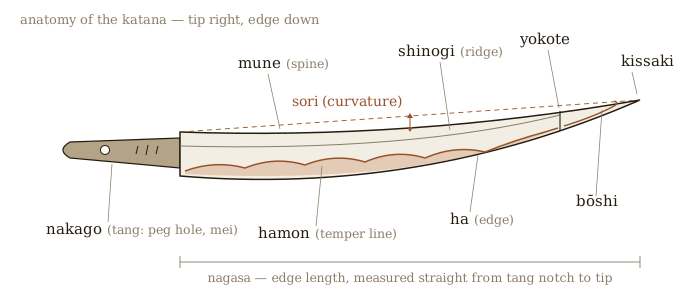
Most of the blade-anatomy terms are easier to see than to read:
Steel and fire
- satetsu — iron-bearing black sand, collected from rivers and hillsides; the raw material of traditional sword steel. Unusually low in phosphorus and sulfur, which is much of why it was worth the trouble.
- tatara — the clay bloomery furnace that smelts satetsu and charcoal into steel over about three days, without ever fully melting the iron. Rebuilt for every smelt.
- kera — the multi-tonne spongy mass of raw steel a tatara produces, broken up and sorted by quality.
- ★ tamahagane — “jewel steel”: the best, highest-carbon fraction of the kera, reserved for sword edges and skins.
- kawagane — skin steel: high-carbon, heavily folded steel forming a blade’s outer surface and edge.
- shingane — core steel: low-carbon, tough steel hidden inside the blade. Kawagane, unlike shingane, is meant to be seen and to cut.
- tanren — the fold-and-weld forging cycle that purifies and homogenizes the steel; the source of the surface grain.
- ★ yaki-ire — the quench: heating the clay-coated blade to about 800 °C and plunging it into water. Creates the hard edge, the hamon, and most of the curvature, and carries the risk of cracking the blade.
The blade
- ★ sugata — a blade’s overall form: length, curvature, proportions, point. The first thing an appraiser reads, because sugata tracks era.
- nagasa — blade length, measured in a straight line from tip to the notch where the tang begins. Legal and traditional classifications key off it.
- ★ sori — curvature: the maximum distance between the spine and a straight line from tip to tang notch. Where along the blade the curve sits deepest is itself a dating clue.
- kissaki — the point section, set off by its own geometry; its size (small, medium, large) is a strong era indicator.
- bōshi — the hamon’s continuation inside the kissaki. Appraisers weight it heavily because it’s hard to fake and survives repolishing poorly.
- mune — the spine, the unsharpened back of the blade.
- ha — the edge; the hardened cutting side. Also in compounds: hasaki (the very edge line), hagire (a crack in it — fatal).
- shinogi — the longitudinal ridge line between edge bevel and spine surface; standard long swords are shinogi-zukuri, “ridge-line construction.”
- ★ nakago — the tang: the unpolished tail of the blade inside the handle, carrying the signature and file marks. Its rust patina is a primary dating tool, which is why cleaning a nakago destroys value.
- mei — the inscription chiseled into the tang: maker, sometimes province, date, or owner. A blade with no mei is mumei, “unsigned.”
- ★ hamon — the temper line: the visible boundary of the quench-hardened edge steel, in shapes from dead-straight (suguha) to waves and clove-flower lobes. Structural, not decorative.
- ★ jigane / jihada — jigane is the visible surface steel itself; jihada is its grain pattern (wood-grain itame, straight masame, burl mokume), the record of the folding.
- ★ nie — hardened-steel crystals large enough to see individually: a frost-like sparkle along the hamon. Produced by hotter, harder quenching.
- ★ nioi — the same crystals too fine to resolve by eye: a continuous mist. Nie and nioi, mixed in different proportions, are the connoisseur’s first-order signature of a school.
- hataraki — “activities”: the small bright features in and around the hamon (streaks, lightning lines, dots) that appraisers read as evidence of technique and quality.
Forms and mountings
- tachi — the older long sword, worn slung edge-down with armor; typically longer and more deeply curved. Signed on the side that faces out when worn — which is how you tell a tachi’s tang from a katana’s.
- ★ katana — the long sword worn thrust through the sash edge-up, standard from the Muromachi period on; drawn and cut in one motion. Legally, a curved blade 60.6 cm (two shaku) or longer.
- wakizashi — the companion short sword, 30.3–60.6 cm; paired with a katana it forms the daishō, the samurai’s two-sword set.
- tantō — a dagger under 30.3 cm, mostly flat-sided (no ridge line); a major art form of the Kamakura period.
- ★ koshirae — a sword’s full formal mounting: lacquered scabbard, wrapped hilt, guard, and fittings, made by separate specialists.
- shirasaya — the plain magnolia-wood “resting” mount a blade lives in for storage. Shirasaya, unlike koshirae, is not built to be worn or used.
- habaki — the fitted metal collar at the blade’s base that seats it in the scabbard and keeps the edge from touching anything. Every blade gets its own, hand-made.
- tsuba — the guard: a field of art collecting in its own right, from austere pierced iron to lavish soft-metal work.
Judgment, people, and eras
- tōshō (also katana-kaji) — the swordsmith: licensed in modern Japan after a five-year apprenticeship, and legally limited in monthly output.
- togishi — the sword polisher: a separate profession, roughly ten years to competence, responsible for both the blade’s geometry and its legibility.
- ★ kantei — appraisal: attributing a blade to an era, school, and ideally an individual smith from its physical evidence — practiced blind on unsigned blades as the field’s core skill and sport.
- gimei — a fake signature: far more common than newcomers expect, which is why the rule is “judge the blade, then the mei,” never the reverse.
- suriage — a blade shortened from the tang end, usually to convert a long tachi to katana length; ō-suriage (fully shortened) blades lose their signatures, which is what makes kantei necessary.
- ★ gokaden — the “five traditions” (Yamashiro, Yamato, Bizen, Sōshū, Mino): the classical school framework used to organize almost all old-sword appraisal.
- kotō / shintō / shinshintō / gendaitō — the four period labels: “old swords” (to ~1596), “new swords” (Edo), “new-new swords” (~1764–1876), and modern blades. A newly made sword is a shinsakutō.
- NBTHK — the Society for Preservation of the Japanese Art Sword: runs the modern tatara, the Japanese Sword Museum, and the shinsa authentication system whose papers anchor the market.