Forging and Folding
The smith turns uneven, slag-ridden furnace steel into clean blade steel by welding fragments into a block and folding it — hammering it out, cutting it partway through, doubling it over, and forge-welding it solid again, a dozen to fifteen times. Each fold doubles the internal layers, so fifteen folds give over thirty thousand, each thinner than a hair; the point is not layering for its own sake but kneading: slag gets squeezed out, carbon gets evened out, and about half the steel is deliberately sacrificed as sparks and scale. The layered structure surfaces in the finished blade as jihada, the wood-grain pattern, which is why the grain is evidence of process rather than decoration. Skin steel is folded more than core steel, and folding past the useful point burns off carbon and erases the grain.
Prerequisites: From Sand to Steel — you need to know how uneven the raw material is, because this whole topic is the payment for that trade. Feeds problems: clean steel from dirty sand, controlling invisible carbon
Practitioner
The smith’s raw material is a crate of tamahagane fragments with wildly varying carbon and slag trapped throughout. Step one is triage. Each piece is heated and hammered into a thin plate, quenched, and snapped; the fracture face is the diagnostic. Bright, fine, almost sugary breaks mean high carbon — edge and skin material (kawagane). Gray, fibrous, reluctant breaks mean low carbon — core material (shingane). The smith is reading carbon content with his eyes, and this sort decides each fragment’s role in the blade.
Step two is building a block. Sorted fragments are stacked into a neat brick on a steel paddle (the smith forges the handle on first, then sacrifices it later), wrapped in paper, coated in clay slurry and rice-straw ash, and brought up to welding heat. The coating melts into a protective glaze that keeps oxygen off the steel — oxygen at welding temperature means scale, and scale trapped in a weld means a flaw. At white heat, sparks streaming, the stack is hammered into a single solid mass. This first consolidation (tsumi-wakashi) is the most failure-prone welding of the whole process.
Now the signature step: orikaeshi tanren, fold-and-weld. Draw the block out long, notch it with a chisel, fold it back on itself, flux it, bring it to welding heat, and hammer it solid. Repeat. Each cycle doubles the internal layers:
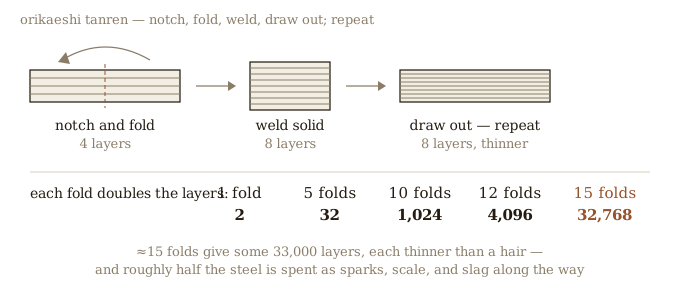
What is folding for? Three things, none of them magic. Slag expulsion: at welding heat the trapped glass is liquid, and every hammer blow on a fresh fold sprays some of it out — that’s much of the spectacular spark shower in photographs. Homogenization: high-carbon and low-carbon regions get stretched thinner and thinner until diffusion smears them together; folding is kneading dough. Structure: the thin residual layering surfaces in the polished blade as jihada — wood-grain itame, straight masame, burl mokume — depending on how the smith alternates folding directions. The grain is the fingerprint of this step, which is why appraisers can read forging practice off a finished blade centuries later.
The dosing matters. Kawagane gets the full treatment — a dozen to fifteen folds — because it shows on the surface and takes the edge. Shingane gets fewer; it’s hidden and its job is toughness, not beauty. And there is a real optimum: every heat burns carbon off the surface, so each fold spends carbon. Fold too few times and the steel stays dirty and streaky; fold too many and you get clean, characterless, decarburized steel — the grain fades toward glassy blankness (muji) and the edge steel loses the carbon it exists to carry. Smiths budget folds the way a baker budgets kneading.
The cost of all this cleaning is mass. Between scale, slag, sparks, and trimmed ends, roughly half the steel that enters the folding process is gone by the end of it — on top of the losses before and after. When you see the price of a hand-forged blade, part of what you’re buying is the pile of steel that was burned to purify the rest.
Expert pointers
The interesting arguments: how much folding is optimal — some smiths and researchers hold that famous kotō-era steel was folded less and less regularly than modern practice, and that some of its liveliness (prominent grain, the misty utsuri effect) comes from incomplete homogenization that modern tidiness trains away. Sectioning studies of damaged historical blades show more variety in practice than the textbook process suggests — construction and fold counts varied by school, era, and probably economics. And hada as a control variable: distinctive grains (the Gassan school’s rippling ayasugi, matsukawa “pine bark”) are deliberately engineered by fold choreography, a reminder that this “purification” step doubles as the school’s visual signature.
Misconceptions
- “Folded a thousand times.” Folds and layers are different words. Ten to fifteen folds produce thousands to tens of thousands of layers. A thousand folds is physically absurd — the steel would long since have burned away.
- “More folds, better sword.” Folding has an optimum, not a gradient. Past it you’re burning off carbon, erasing grain, and paying mass for nothing. The skill is knowing when to stop.
- “Folding makes the blade strong like layered composites.” After proper welding, the layers are metallurgically continuous steel, not laminate plies — folded steel doesn’t work like plywood or carbon fiber. Folding’s strength contribution is removing weaknesses (slag, carbon streaks), not adding a laminate superpower. The genuine composite engineering in a nihontō is the next topic’s skin-and-core construction.
Check yourself
- A smith folds one billet 8 times and an identical billet 16 times. Describe the likely differences in slag content, carbon content, carbon distribution, and visible grain — and which billet you’d want for core steel.
- Why does the smith coat the stacked billet with clay slurry and straw ash before welding heat? What failure is being prevented, and when would it otherwise show up?
- Folding is often called purification. What does it actually remove, what does it merely redistribute, and what does it unavoidably lose?
- An appraiser sees strong straight-grained masame on a blade’s surface. What does that tell her about what happened in the smithy — and why can’t a fake achieve it with surface etching?
Apply it
Two exercises, ~20 minutes each; do at least the second. (1) Extend your topic-05 budget: model 6 kg of billet through 14 folds with ~5% mass loss per fold and a small carbon loss per heat — chart mass and layer count against fold number, and find where the curves argue for stopping. (2) Train your eye on jihada: pull up high-resolution blade photos from an online museum collection (the e-Museum national-treasures site or the Met’s arms and armor collection work well), and classify the grain of ten blades as itame, mokume, masame, or mixed. Save your ten calls with links — they’re kantei practice for Schools, Eras, and Kantei and raw material for a field-guide capstone.