Geometry and Construction
A Japanese blade is a composite: hard, folded skin steel wrapped around a soft core, in arrangements from a simple jacket (kobuse, today's standard) to three- and four-part assemblies. The welded billet is drawn out into a bar with the blade's rough proportions, then forged into its final cross-section — ridge line, bevels, spine — and its silhouette: length, curvature, and point size. That silhouette, the sugata, is the single most historically loaded property of the blade, because it tracked how wars were fought: deep-curved cavalry tachi in the Kamakura period, oversized blades and giant points in the fourteenth century, shorter belt-worn katana when combat moved to foot, shallow refined curves in the peaceful Edo era. Appraisers read shape first; it dates a blade before any other evidence is considered.
Prerequisites: Forging and Folding — kawagane and shingane are the ingredients here. Feeds problems: hard enough to cut, tough enough to survive, knowing what you’re looking at
Practitioner
Start with the problem from Big Problems: hard and tough is a contradiction in one steel. The construction step is the structural half of the answer. The smith has two prepared steels — hard, well-folded kawagane and tough, low-carbon shingane — and welds them into a single billet whose cross-section puts each where its virtue pays:
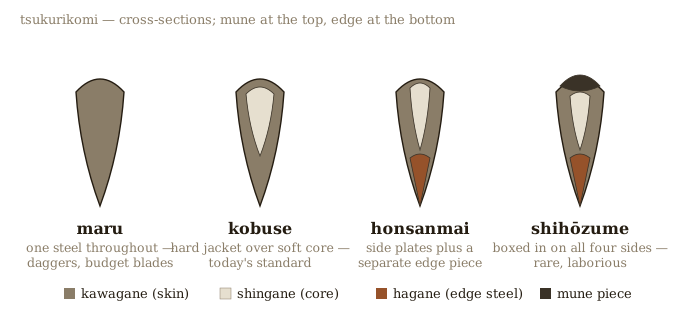
The menu, roughly in order of effort: maru — one steel throughout, no core; common in daggers (thin blades have no room for a core) and in cheaper blades. Kobuse — a U of kawagane wrapped over a shingane core, so the skin and edge are one piece of hard steel; the workhorse construction of modern smiths and of history’s mass-production eras. Honsanmai — side plates plus a dedicated edge piece; more control, more welds. Shihōzume and rarer schemes box the core in with up to four different steels. More pieces buy finer control over where hardness lives — and multiply the welds, each a potential flaw. Legend credits the great Sōshū smiths with seven-piece constructions; the balance of modern evidence treats that as posthumous mythology.
With the billet welded, the smith draws it out (sunobe): hammers it into a plain bar with the finished blade’s rough length, taper, and distribution of mass, with the point cut at an angle at the end. Everything is budgeted here — the bar contains the future blade’s proportions the way a sculptor’s armature contains the pose. Then hizukuri, shaping: working section by section, the smith forges in the cross-section — the shinogi ridge line, the flat spine, the long bevels down to what will become the edge. This is freehand hammer work to tight tolerances; files and scrapers refine it, but the geometry is made at the anvil, and it’s forged very close to straight. The curve comes later, from the quench — hold that thought for the next topic.
Learn four geometry words and blades stop looking alike. Zukuri — the construction style of the cross-section: shinogi-zukuri (ridged — nearly all long swords) versus hira-zukuri (flat-sided, no ridge — most daggers). Mune — the spine’s own shape (peaked, flat, rounded; a minor school tell). Kissaki — the point, with its own facets and a dividing line (yokote) separating it from the body; its proportions run from the stubby points of early blades through medium to the dramatic elongated points of the fourteenth century. Niku — “meat”: the convexity of the bevel surfaces. More niku makes a durable, armor-tolerant edge; less makes a wicked slicer that chips easier. When people say a polisher “preserved the blade’s health,” niku is much of what they mean.
Now the payoff idea: sugata is a date stamp. Fighting style dictated form, and form changed century by century — which is why appraisal starts with the silhouette:
| Era | What war wanted | What blades look like |
|---|---|---|
| Heian–early Kamakura (~950–1250) | Mounted archers’ sidearm; slashing from horseback | Slender tachi, deep curve concentrated near the tang, small point |
| Late Kamakura (~1250–1330) | Heavier armor after the Mongol invasions | Wider, more robust blades; stout or medium points |
| Nanbokuchō (~1330–1390) | Field warfare escalation; intimidation | Oversized blades (some later cut down), shallow curve, huge elongated points |
| Muromachi (~1390–1570) | Massed infantry; sword drawn from the belt | Shorter uchigatana/katana, curve shifted toward the tip for the draw |
| Edo / shintō (~1600–1780) | Peace: dueling, status, aesthetics | Standardized katana length, shallow refined curve, textbook proportions |
| Shinshintō–modern (1780–) | Revivalism | Deliberate re-creations of older sugata — dating gets subtler |
The table is a caricature — every era has exceptions — but it’s the caricature every appraiser carries, and it works. A blade’s shape narrows its date to within a century or so before grain or hamon enter the conversation.
Expert pointers
Where practitioners argue: construction versus performance — controlled comparisons of kobuse against well-heat-treated monosteel are scarce, and honest smiths concede modern monosteel can match or beat composite blades mechanically; the composite’s case today rests on tradition, repairability, and the aesthetics of exposed skin steel. What historical blades are actually made of — X-ray, neutron, and metallographic studies of damaged blades keep finding simpler and more varied construction than the school textbooks claim, including famous-school blades that are essentially maru. Utsuri, the misty shadow above the hamon on classic Bizen blades, sits half in this topic and half in the next: partly a steel-and-forging phenomenon, partly heat-treatment, mechanism still genuinely contested.
Misconceptions
- “The curve is forged into the blade.” The blade leaves the shaping stage close to straight; most of the final curvature appears during the quench, from differential transformation. The smith plans the curve, but water executes it.
- “More lamination pieces means a better blade.” Each extra piece adds welds, and welds are where flaws live. Kobuse has dominated for centuries because it’s the least construction that fully solves the problem — a lesson in engineering parsimony, not a compromise.
- “A sharper edge angle is always deadlier.” Edge geometry trades durability against slicing aggression (that’s niku). Battlefield blades carried meat on the edge for the same reason axes do; razor-thin geometry belongs to peacetime cutting practice — and to blades that chip.
Check yourself
- Why does kobuse construction put the fold of the hard-steel U at the edge rather than seaming two plates there? Think about where welds fail.
- A dagger and a katana from the same smith: why is the dagger likely maru while the katana is kobuse? Two reasons — one geometric, one mechanical.
- You’re handed a blade with a shallow curve biased toward the tip, 68 cm long, medium point. Which era does the silhouette suggest, and what was that shape for?
- Where did the fourteenth century’s taste for enormous points come from, and why did later generations cut many of those blades down? What does a cut-down blade lose forensically?
Apply it
Do sugata dating from scratch (~45 minutes): in an online museum collection with dated attributions (e-Museum, ColBase, or the Met), pull side-on photos of six to eight blades spanning Kamakura through Edo. For each, before reading the label, measure with a ruler on screen: length-to-curvature ratio, where along the blade the curve is deepest, and point length relative to blade width. Plot your measurements on a timeline, then check the labels. You will get most eras right on shape alone — and you’ll have generated a dataset that can grow into a capstone prototype (a sugata-dating chart or quiz) in Be Creative.