The Map
Japanese swordmaking is a chain of separate crafts: smelting iron sand into steel in a clay furnace, forging and folding that steel clean, shaping a blade with a hard skin and a soft core, quenching it under a painted clay jacket so the edge hardens while the spine stays tough — which is also what creates the curve and the temper line — then handing it to a polisher who spends weeks making the steel's structure visible, and to mount-makers who build its scabbard and fittings. Around the making sits a second discipline, appraisal: reading a blade's shape, grain, and temper line to tell when, where, and by whom it was made. The hard problems live in controlling invisible carbon without instruments, surviving the one-shot quench, attributing unsigned blades, and keeping the whole endangered ecosystem of crafts alive.
Everything in this hub fits on this one page. Read it first; every later section is a zoom-in on something you see here.
The pipeline
A Japanese sword (nihontō) is not made by one person. It moves through a chain of specialists, and the chain itself is the best map of the domain:
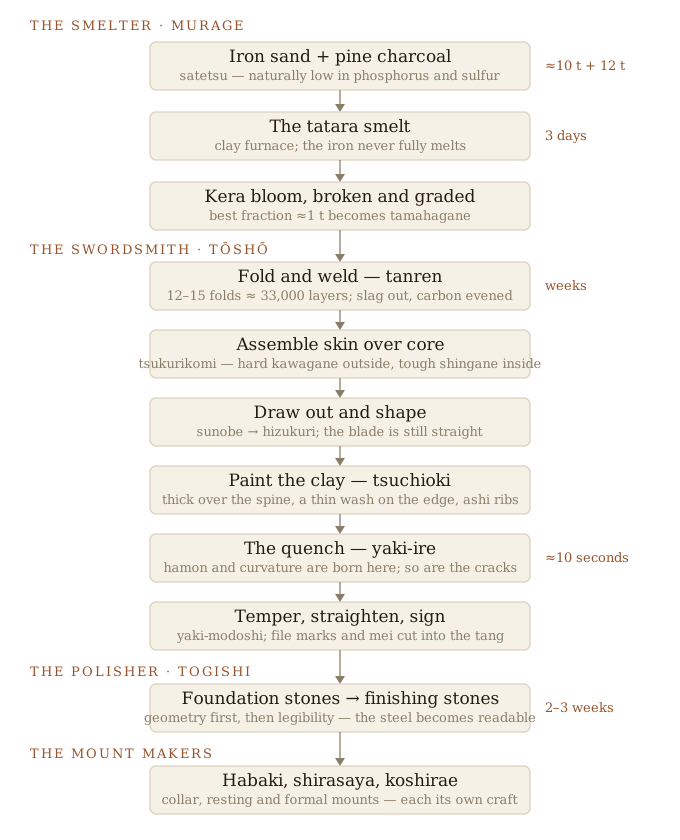
Each stage is a subfield with its own people, tools, and judgment calls. In plain language:
- Steelmaking. Iron-bearing black sand and pine charcoal go into a clay furnace called a tatara for three days and nights. The furnace never fully melts the iron; it produces a spongy mass of steel, and the best pieces of that mass — tamahagane, “jewel steel” — are what swords are made from.
- Forging and folding. The smith sorts steel fragments by how much carbon they contain (judged by eye, from the way they fracture), welds them into a block, and folds it a dozen or so times. Folding squeezes out impurities and evens out the carbon — it’s purification, not magic — and as a side effect creates the wood-grain pattern visible in the finished surface.
- Construction and shaping. Hard steel is brittle; soft steel is weak. So most blades are built as a composite: a hard skin and edge wrapped around a soft core, then drawn out and forged into the blade’s profile. The silhouette — length, curvature, point size — varies by century, which is why experts can date a blade from its shape alone.
- The quench. The smith paints the blade with clay — thick on the spine, thin along the edge — heats it to about 800 °C, judging temperature entirely by color in a darkened forge, and plunges it into water. The thinly-coated edge cools fast and becomes glass-hard; the thick-coated spine cools slowly and stays tough. The hardened zone’s boundary is the hamon, the temper line; the transformation also bends the blade, creating most of its curve. This is the moment of highest drama: a blade that cracks here is scrap.
- Polishing. A separate profession entirely. The polisher (togishi) spends two to three weeks moving through a sequence of ever-finer stones — not mainly to sharpen, but to make the steel legible: the grain of the folding, the crystalline sparkle of the hardened edge, everything an appraiser reads.
- Mounting. More separate professions: one artisan makes the fitted metal collar that locks the blade into its scabbard, others make the scabbard, the ray-skin-and-silk handle, and the guard. A blade “rests” in a plain wooden storage mount and dresses up in a lacquered formal one.
- Appreciation and appraisal (kantei). The discipline of reading blades: identifying the tradition, era, and ideally the individual smith from shape, grain, and temper line — necessary because many old blades are unsigned or shortened, and because forged signatures have been common for centuries.
- History. The sword’s form tracked Japan’s wars and politics for a millennium — cavalry sabers, battlefield mass production, peacetime art objects, a near-death experience in the twentieth century, and today’s licensed revival. This hub doesn’t give history its own topic; it’s woven through the shaping and appraisal topics, where it does real work.
What depends on what
The dependency structure is close to linear, which makes the reading order easy:
- Steelmaking (topic 05)
- Forging and folding (06) — you can’t understand folding without knowing how dirty and uneven the raw steel is
- Construction and shaping (07) — composite structure only makes sense once you know skin steel and core steel exist
- The quench (08) — clay, curvature, and the hamon; needs the blade’s geometry
- Polishing (09) — reveals what 05–08 created
- Mounting (10) — everything around the finished blade
- Appraisal (11) — reads everything 05–09 left in the steel; leans on 07 hardest
- Polishing (09) — reveals what 05–08 created
- The quench (08) — clay, curvature, and the hamon; needs the blade’s geometry
- Construction and shaping (07) — composite structure only makes sense once you know skin steel and core steel exist
- Forging and folding (06) — you can’t understand folding without knowing how dirty and uneven the raw steel is
What this hub covers, and what it only points to
Topics 05 through 11 cover the pipeline and appraisal in depth. Three neighboring areas are pointed to but not taught: sword fittings as an art field of their own (guards and hilt furniture have their own schools, literature, and collectors), swordsmanship (how blades are used tells you why they’re shaped as they are, but it’s a different domain), and deep metallurgy (we use phase transformations at working depth — enough to explain what the smith is doing — without the full materials-science apparatus). Go Deeper has entry points for all three.
Where the hard problems live
Four tensions organize the whole field, and you’ll meet them formally in Big Problems: controlling carbon you cannot see with no instruments beyond the smith’s senses; resolving hard-but-tough, the contradiction at the heart of every sword; surviving the one-shot quench, where months of work ride on ten seconds; and attribution — knowing what an unsigned blade is — plus the modern meta-problem of keeping the craft alive when a sword takes months to make and the artisans who support it are down to double digits.