Waste, Materials & Toxics
Modern economies run a linear pipeline: extract raw materials, make products, use them briefly, and discard them. Because there is no "away," everything we throw out accumulates somewhere — landfills, oceans, the air, our bodies. Plastics are the emblem: cheap, durable, barely recycled, and now fragmenting into microplastics found everywhere on Earth. A separate, quieter danger is toxic chemicals, especially persistent ones like PFAS "forever chemicals" that don't break down and build up as they climb the food chain. The deep cause is economic: virgin materials are cheap because the pollution of extraction and disposal is unpriced, so recycling loses on cost. The alternative is a circular economy — designing products to be durable, repaired, and looped back into use — which fights an economy built for single use but is the only real answer to a world of finite materials.
Prerequisites: Earth as a System, Measuring the Environment Feeds problems: closing the materials loop
Practitioner
The whole topic follows from one mental model: there is no “away.” Matter is conserved, so everything we discard has to be somewhere. Modern economies are built to ignore this — they run a straight pipeline that takes materials from the earth, makes things, sells them for a short use, and discards them. Draw that pipeline and you see the problem immediately: it’s open at both ends, mining a finite planet at one end and piling waste at the other.
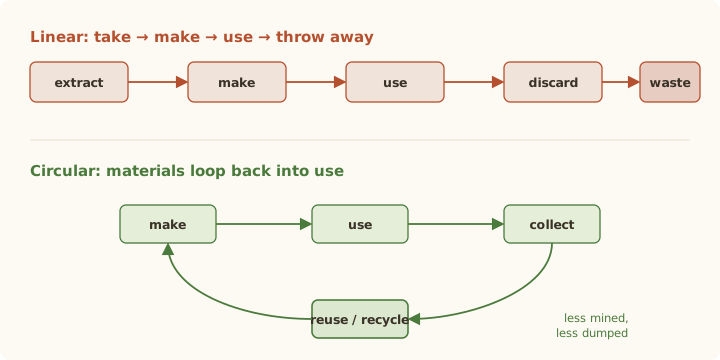
The linear model treats “away” as real. The circular model closes the loop so materials keep their value instead of becoming waste.
Plastics are the emblematic case, and worth understanding in detail because they teach the general lesson. Plastic is a triumph — cheap, light, durable, sterile — and its virtues are exactly its curse. It’s durable, so it doesn’t break down for centuries; it’s cheap, so there’s little economic reason to recover it; and it’s made in thousands of incompatible formulations, so it’s hard to recycle even when collected. The result: despite decades of recycling messaging, only a small fraction of plastic is actually recycled. Most is landfilled, burned, or leaks into the environment, where it fragments into microplastics now found from mountain snow to the deep sea to human blood. And here’s the uncomfortable history a practitioner should know: recycling was promoted heavily by the plastics industry itself, in part to shift responsibility from producers to consumers and forestall bans — a case study in greenwashing and downstream misdirection.
Toxic chemicals are the quieter, in some ways more insidious problem. We’ve created tens of thousands of synthetic compounds, most never tested for long-term or combined effects. The dangerous ones share a profile: persistent (they don’t break down), bioaccumulative (they build up in bodies), and mobile (they spread far from where they’re used). PFAS — “forever chemicals” in nonstick pans and waterproof gear — are the current headline: essentially indestructible, now in the blood of nearly everyone on Earth, and linked to a growing list of health harms. Bioaccumulation is the mechanism that makes persistence so dangerous: a substance too dilute to matter in water concentrates as it climbs the food chain, so top predators — and people — carry the highest doses. It’s the same story that made DDT and mercury notorious.
Now the part that explains why the linear model persists despite everyone knowing better: it’s cheaper, because the true costs are unpriced. Virgin plastic from cheap oil usually costs less than collecting, sorting, and reprocessing used plastic. Dumping is cheaper than designing for disassembly. The pollution of extraction and the burden of disposal are externalities — real costs pushed onto ecosystems, the public, and the future, invisible on the producer’s balance sheet. So the market rationally chooses take-make-waste. This is why “recycle more” as a consumer exhortation is downstream and weak: it can’t overcome an upstream price structure that rewards the linear model.
The real answer is to change the design and the incentives — the circular economy shown above. In a circular system, products are designed from the start to be durable, repairable, and eventually disassembled and looped back into use, so materials keep their value instead of becoming waste. The leverage is upstream, at the design and business-model level, not at the recycling bin. The concrete levers, mostly policy: extended producer responsibility (make the maker pay for end-of-life, so they design for it), right-to-repair rules, deposit-return schemes (which actually achieve high recovery), and outright bans on the worst materials and chemicals. Each works where it’s enacted; each fights strong economic headwinds and can, done carelessly, shift the problem somewhere else rather than solving it — the no-“away” trap again, now at the level of policy.
Expert pointers
The technical frontier is advanced recycling — chemical processes that break plastics back into feedstock rather than merely downcycling them — which is promising but energy-intensive and often over-hyped; treat bold claims with the measurement skepticism from earlier. On chemicals, the contested frontier is regulating PFAS as a whole class rather than one compound at a time (industry prefers the slow one-by-one route), and the general shift from “innocent until proven harmful” toward the precautionary principle. Materials science aimed at genuinely benign, compostable, or infinitely recyclable substances is an active and hopeful field.
Misconceptions
- “Recycling solves plastic waste.” Only a small share of plastic is actually recycled, and most recycling is downcycling to a lower-value product headed for landfill anyway. Reducing and redesigning beat recycling; the bin is the last resort, not the answer.
- “If a chemical is legal and in products, it must be safe.” Most chemicals in use have never been tested for long-term or combined effects, and regulation typically lags the science by years — the precautionary principle exists precisely because “no proof of harm” isn’t proof of safety.
- “Waste is the individual consumer’s responsibility.” The dominant cause is upstream: products designed for single use and priced with disposal costs externalized. Consumer effort can’t out-sort a system built to make waste.
Check yourself
- Using “there is no away,” explain why building taller incinerator stacks or shipping waste abroad aren’t real solutions.
- Why does the market keep choosing virgin plastic over recycled, even when everyone agrees recycling is better? What would change the calculation?
- What three properties make a chemical like PFAS especially dangerous, and how does bioaccumulation turn a “harmless” dilute dose into a real threat?
- Why is “extended producer responsibility” an upstream lever while “recycle more” is a downstream one — and why does that difference matter?
Apply it
For one day, keep everything you would normally throw away instead of binning it, then sort the pile and pick the single biggest item or category. Trace it upstream: who designed it to be disposable, and what design or policy change would have prevented it existing? One honest day of your own waste is a sharper teacher than any statistic — and a strong seed for a redesign proposal or prototype. (~20 minutes plus a day of collecting)