Big Problems & High-Value Solutions
Eight problems hold most of the field's value. Decarbonizing the energy system is the master problem, hard because fossil fuels are cheap, dense, and woven through everything. Feeding ten billion people is a land-and-water problem that competes directly with nature. Biodiversity is collapsing from many causes at once, with no single fix. Clean air and water are mostly solved technically but not politically or financially. Closing the materials loop fights an economy built for single use. Underneath all of them sits the governance problem: pollution is unpriced and the atmosphere is a global commons, so the incentives point the wrong way. Two more cut across everything — adapting justly to change already locked in, and simply knowing the truth about who is emitting and whether claims are real.
This is the field’s value structure — where the effort and the money go, and why. Each problem below is stated plainly, then comes the part that matters most: why it’s genuinely hard, not a slogan. Then the best current solutions and where they fall short. Every entry points to the topics that equip you to engage with it. A filtering rule runs through the whole hub: if a topic doesn’t connect to one of these problems, it doesn’t belong.
1. Decarbonizing the energy system
The problem: most greenhouse-gas emissions come from burning fossil fuels for electricity, transport, industry, and heat. To stop climate change we have to run modern civilization without adding carbon to the air — and do it while energy demand is still rising.
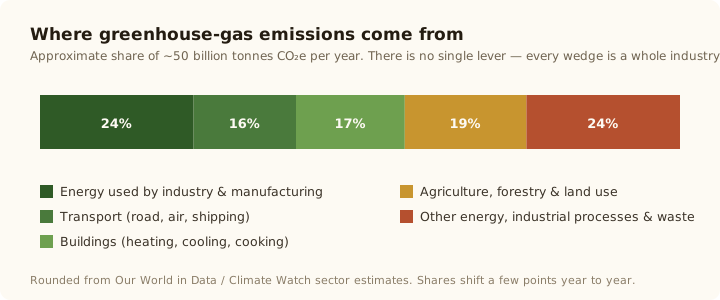
There’s no single source to switch off. Emissions are spread across every sector of the economy.
Why it’s hard: fossil fuels are extraordinarily good at their job — cheap, energy-dense, storable, and available on demand. Their damage is an externality nobody pays for, so clean alternatives compete on an unfair field. And as the chart shows, there’s no one thing to fix: even a perfect clean grid leaves transport, steel, cement, farming, and aviation, each needing its own solution. The system also has enormous inertia — power plants and vehicles last decades.
Best solutions and limits: solar and wind are now the cheapest new electricity in most of the world, which solves the biggest wedge. But they’re intermittent, so scaling them needs storage, grid expansion, and flexible demand that lag behind. The hardest sectors — heavy industry, aviation, shipping — have no cheap answer yet; candidates like green hydrogen and carbon capture remain expensive and small. Equips you: Energy & the Transition, Climate & Carbon.
2. Feeding ten billion people within the planet’s limits
The problem: agriculture already uses about half the world’s habitable land and most of its fresh water, and drives a large share of emissions and biodiversity loss. We need to feed a growing, richer population eating more meat — without converting the remaining wild land or draining the rivers.
Why it’s hard: food production competes directly with nature for the same land and water, and the most environmentally damaging foods (beef especially) are the ones rising demand wants most. Yields can be pushed higher with fertilizer and irrigation, but those cause their own harm — eutrophication, aquifer depletion, soil degradation. Every lever trades one problem for another, and hundreds of millions of livelihoods ride on the outcome.
Best solutions and limits: closing “yield gaps” so existing farmland produces more, shifting diets toward plants, cutting the roughly one-third of food that’s wasted, and precision techniques that use less fertilizer and water. Each helps; none is sufficient alone, and diet change in particular runs into culture, price, and politics. Equips you: Land, Food & Forests, Biodiversity & Ecosystems.
3. Halting the collapse of biodiversity
The problem: wild populations of animals have fallen dramatically in the last half-century, and species are going extinct far faster than the natural background rate. This thins the living fabric that provides pollination, clean water, fisheries, and stability.
Why it’s hard: unlike climate, biodiversity has no single metric and no single cause. It’s pushed by habitat loss, overexploitation, pollution, invasive species, and climate change at once, so there’s no equivalent of “cut CO₂.” Its value is mostly an externality too — a forest is worth more cleared and sold than left standing, on any balance sheet that ignores its services. And losses can cross thresholds that don’t reverse.
Best solutions and limits: protected areas (the global goal is 30% of land and sea by 2030), restoration, and paying landowners for the ecosystem services they preserve. Protection works where it’s funded and enforced, but “paper parks” with no resources are common, and protection can conflict with local livelihoods if imposed without them. Equips you: Biodiversity & Ecosystems, Land, Food & Forests.
4. Clean air and safe water for everyone
The problem: air pollution kills millions of people a year, and billions lack reliably safe drinking water and sanitation. These are among the largest environmental harms to human health, and they hit the poor hardest.
Why it’s hard: the technical solutions are largely known — the obstacles are money, institutions, and politics. Cleaning up requires upfront investment whose benefits (fewer sick people, longer lives) are diffuse and delayed, so they lose to concentrated present costs. Pollution also crosses borders and jurisdictions, so no single authority owns the problem. Much of the harm is invisible: PM2.5 has no smell and its victims die of heart disease years later.
Best solutions and limits: emissions standards, cleaner fuels and cookstoves, and closing the sources (coal plants, dirty vehicles) — the same shift that decarbonization drives, which is a major co-benefit. For water, treatment and sanitation infrastructure. All are proven; the limit is financing and governance capacity, especially where they’re needed most. Equips you: Air & Water, Energy & the Transition.
5. Closing the materials loop
The problem: we run a linear economy — extract, make, use briefly, discard — that mines finite materials at one end and piles up waste, plastic, and toxic chemicals at the other. There is no “away” for any of it.
Why it’s hard: the whole economy is built and priced for single use. Virgin materials are usually cheaper than recycled ones because the pollution cost of extraction and disposal is an externality. Products aren’t designed to be taken apart, recycling is technically lossy, and some modern materials (forever chemicals, mixed plastics) resist reprocessing entirely. Fixing it means redesigning products and business models, not just sorting bins better.
Best solutions and limits: designing for durability and repair, making producers responsible for their products’ end of life, deposit-return schemes, and banning the worst chemicals outright. These work where mandated, but they fight strong economic headwinds and can shift problems geographically rather than solving them. Equips you: Waste, Materials & Toxics.
6. Making the price tell the truth (the governance problem)
The problem: almost every problem above shares a root cause — environmental damage is unpriced, and the biggest resources (atmosphere, oceans) are a global commons no one owns. So rational actors overuse them, and clean choices are penalized.
Why it’s hard: the fix — pricing pollution and coordinating globally — runs into the hardest problems in politics. Carbon pricing concentrates visible costs now for diffuse benefits later, which is electoral poison. And climate is a global commons where any one country that acts alone bears the cost while the world shares the benefit, so everyone waits for everyone else. Enforcement across sovereign nations has no world police.
Best solutions and limits: carbon pricing (now covering a growing share of global emissions), international agreements like Paris, regulation, and subsidies that make clean options cheaper. Prices work but are set too low and cover too little; treaties like Paris are voluntary and under-enforced; subsidies cost public money. Progress is real but slower than the physics requires. Equips you: Governance, Economics & Justice, Energy & the Transition.
7. Adapting to what’s already locked in — fairly
The problem: because of lags, a degree of warming and its consequences are already committed regardless of what we do next. We have to adapt — and the people most exposed did the least to cause it.
Why it’s hard: adaptation is unglamorous, locally specific, and expensive, with benefits that only show up as disasters that didn’t happen — a hard thing to fund or take credit for. It also collides with justice: the countries and communities facing the worst impacts have the fewest resources to adapt, raising unresolved questions of who pays. And you can’t adapt your way out of unlimited warming, so it can’t substitute for mitigation.
Best solutions and limits: resilient infrastructure, early-warning systems, drought- and flood-tolerant agriculture, and climate finance flowing from rich emitters to vulnerable nations. The techniques work; the finance is far short of what’s promised, and adaptation has hard limits — past some point, places become unlivable. Equips you: Governance, Economics & Justice, Climate & Carbon.
8. Knowing the truth: measurement and accountability
The problem: you can’t manage or argue about what you can’t measure. Who is emitting what, whether a company’s “net zero” claim is real, whether a forest offset actually stored carbon — these are contested, and bad information paralyzes action.
Why it’s hard: emissions are invisible and distributed across billions of sources; self-reported corporate data is easy to game; and greenwashing is often technically-true-but-misleading rather than an outright lie, which makes it hard to police. Establishing a credible baseline and proving a reduction is additional (wouldn’t have happened anyway) is genuinely difficult science.
Best solutions and limits: independent satellite monitoring (methane leaks and deforestation are now watched from orbit), mandatory standardized disclosure, life-cycle assessment, and third-party verification of offsets. These are improving fast, but standards are still fragmented and enforcement is weak, so the burden often falls on informed readers to tell substance from spin. Equips you: Measuring the Environment, Earth as a System.