Climate & Carbon
Climate change is an energy-balance problem. Sunlight warms the Earth, the Earth radiates heat back toward space, and greenhouse gases act like a blanket that lets sunlight in but slows heat's escape. Add more gas — mostly CO2 from burning fossil fuels — and the planet warms until the books balance again. Because CO2 accumulates like water in a bathtub, only net zero stops the warming; slowing emissions merely slows the rise. Warming isn't the whole story: it shifts rainfall, raises seas, acidifies oceans, and loads the dice for extreme weather, with long lags that commit us to more change than we've yet felt. It's the master problem because it amplifies almost every other one in this hub.
Prerequisites: Earth as a System, Measuring the Environment Feeds problems: decarbonizing energy, adapting to locked-in change
Practitioner
Climate change sounds complicated and is, underneath, one tidy piece of physics: an energy balance. The Earth is warmed by incoming sunlight and cooled by radiating heat back to space. In the long run those two must balance, and the balance point sets the temperature. Anything that traps outgoing heat forces the planet to warm until it radiates enough to balance again.
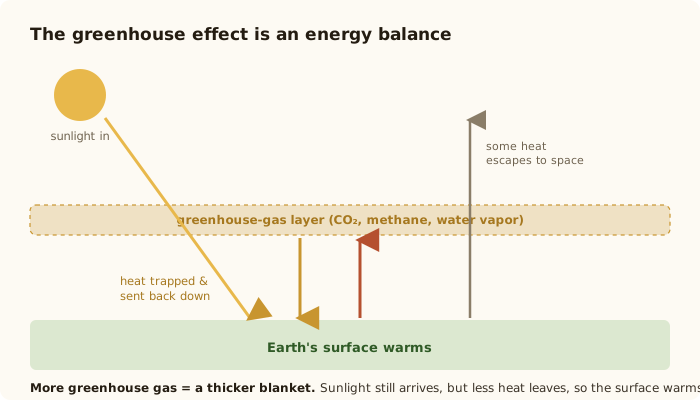
Sunlight comes in; heat tries to leave. Greenhouse gases slow the leaving, so the surface warms until balance returns.
Greenhouse gases are the trap. They’re transparent to incoming sunlight but absorb and re-radiate outgoing heat — a one-way blanket. CO₂ is the big one because we emit so much of it and it lingers for centuries; methane traps far more heat per tonne but breaks down in about a decade; water vapor amplifies whatever the others start. This is not controversial physics — it’s been understood since the 1800s and is why Venus is an oven and Mars a freezer.
Now recall the bathtub, because it governs everything about the solution. CO₂ accumulates: what we emit stays for centuries, and nature only drains about half of each year’s addition. So the atmospheric level keeps rising as long as we emit faster than nature removes — which means stabilizing the climate requires reaching net zero, not merely emitting less. This single fact explains why “we cut emissions 20%” is progress on the tap but not on the water level, and why targets are phrased as net zero by a date.
What does the warming actually do? Not just “hotter everywhere by the same amount.” The heat redistributes:
- It shifts water around. A warmer atmosphere holds more moisture, so wet places tend to get wetter downpours and dry places drier droughts. Rainfall belts move, disrupting the agriculture built around where they used to be.
- It raises seas, through two mechanisms: water expands as it warms, and land ice melts into the ocean. This one has enormous lag — it continues for centuries after temperatures stabilize.
- It acidifies oceans. About a quarter of our CO₂ dissolves into seawater, forming carbonic acid. This is a separate problem from warming, driven by the same emissions, and it threatens shell-forming life from coral to plankton.
- It loads the dice for extremes. Climate doesn’t cause any single storm, but it changes the odds — making heatwaves hotter and more frequent, and giving storms more energy and moisture. Attribution science can now quantify how much.
Two numbers anchor practitioner conversations. The first is the temperature target: the Paris Agreement aims to hold warming “well below 2°C” and ideally 1.5°C above pre-industrial — thresholds chosen because risks climb steeply beyond them. The second is the carbon budget: because warming tracks cumulative CO₂, there’s a finite total we can still emit for a given target. It’s a bank account with a fixed balance, spent at tens of billions of tonnes a year, and it reframes the problem from “emit less” to “we have a fixed amount left, so how fast do we stop?”
Finally, the reason this topic sits at the center of the hub: climate is a threat multiplier. It worsens droughts that stress food and water, pushes species past their ranges, intensifies the disasters that hit the poor hardest, and strains every ecosystem already under pressure. Fix climate and you ease a dozen other problems; ignore it and it corrodes progress on all of them.
Expert pointers
The live scientific debate isn’t whether we’re warming but how much per tonne and how fast the surprises come — climate sensitivity (warming per doubling of CO₂) and the behavior of tipping elements like ice sheets and ocean circulation, where uncertainty is large and asymmetric (the bad tail is very bad). On the response side, the frontier arguments are about carbon dioxide removal — whether we can pull CO₂ back out at meaningful scale and cost — and solar geoengineering, the contested idea of reflecting sunlight to buy time, which raises governance and moral-hazard questions as thorny as the science.
Misconceptions
- “Cutting emissions will cool the planet.” Cutting emissions slows the rise. Temperature roughly stabilizes only at net zero, and falls only with net-negative emissions — the bathtub again.
- “It’s just a couple of degrees — so what?” A few degrees of global average is enormous: the last ice age, with mile-thick ice over cities, was only about 5°C colder on average. Small averages hide large local extremes.
- “CO₂ is plant food, so more is good.” Plants do use CO₂, but the warming, drought, and heat stress that come with it overwhelm any fertilization effect for most crops — and it does nothing for ocean acidification.
Check yourself
- Explain, using the energy-balance picture, why adding greenhouse gas warms the planet even though sunlight input hasn’t changed.
- A country halves its annual emissions and celebrates. Using the bathtub, explain what happens to atmospheric CO₂ and global temperature, and what it would actually take to stop the warming.
- Ocean acidification and global warming have the same cause but are different problems. Explain the mechanism of each and why cutting CO₂ is the only fix for both.
- Why does the idea of a fixed “carbon budget” follow from warming depending on cumulative emissions rather than the current emission rate?
Apply it
Find your country’s or your city’s net-zero target and its current annual emissions, then do the back-of-envelope math: at today’s rate, how many years until it should hit zero, and what straight-line yearly cut does that imply? Note whether current trends are anywhere near that slope. This gap between pledge and trajectory is the raw material for a sharp review or a proposal. (~30 minutes)