Core Mental Models
Nine ideas carry most of the field. The planet runs on cycles that have budgets, so overloading an inflow piles up a stock — and a stock like atmospheric CO2 keeps rising until inflow equals outflow (the bathtub). We live inside a safe operating space bounded on nine fronts, several already crossed. Matter never disappears, so "throwing away" only moves a problem. Most damage happens because pollution is an externality — a cost pushed onto others that no price captures — and because shared resources are a commons that everyone drains and no one guards. Natural systems don't fail gently: they cross thresholds and tip, and they respond with long lags, so today's emissions commit us to tomorrow's harm. The payoff is leverage: intervene upstream, near the driver, not downstream at the symptom.
These nine ideas are the trunk. Learn them and the rest of the hub is detail hanging off a frame you already understand. They’re not the most famous ideas in environmentalism — they’re the most load-bearing, the ones whose absence makes everything else confusing.
1. Everything is a cycle, and cycles have budgets
Carbon, water, nitrogen, and phosphorus don’t get used up — they move in loops through the air, oceans, rocks, and living things. Carbon cycles from the atmosphere into a plant, into an animal, into the soil, and back to the air. These cycles ran in rough balance for a very long time. Human activity doesn’t destroy a cycle; it changes the rate of one part of it — we move carbon out of the ground and into the air far faster than the slow parts of the cycle can pull it back.
Why it’s load-bearing: almost every environmental problem is a cycle knocked out of balance. Once you see “which flow did we speed up, and where does the extra pile up?”, climate change, ocean acidification, and fertilizer runoff all become variations on one question.
Concrete example: we mine phosphorus, spread it on fields as fertilizer, and it washes into rivers and lakes, where it feeds algae blooms that suffocate the water. Same element, one cycle, thrown out of balance at both ends.
Common misconception: that pollution is a substance that’s inherently bad. Nitrogen and phosphorus are essential nutrients; carbon is the basis of life. The harm is about rate and place — too much, too fast, in the wrong reservoir.
2. Stocks and flows: the bathtub
A flow is a rate (tonnes of CO2 emitted per year); a stock is an accumulated amount (the total CO2 now in the air). Picture a bathtub: the tap is emissions, the drain is nature soaking carbon back up, and the water level is the stock in the atmosphere. The level rises whenever the tap runs faster than the drain — and the level, not the tap, is what warms the planet.
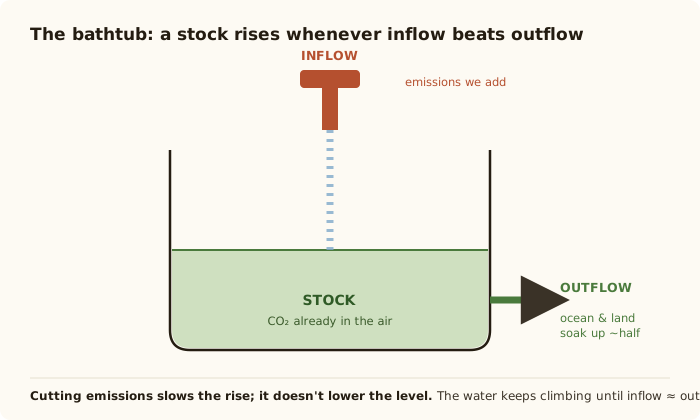
Reducing the inflow slows the rise. Stopping the rise takes inflow falling to meet outflow — that’s net zero.
Why it’s load-bearing: it explains the single most misunderstood point in climate policy. Cutting emissions by 30% doesn’t lower CO2 in the air; it just makes the level rise more slowly. Stabilizing the climate requires emissions to fall until they match what nature removes — net zero — after which the level finally stops climbing.
Concrete example: through the 2010s global emissions roughly plateaued, and commentators cheered. But a flat tap on a running bathtub still fills the tub — atmospheric CO2 kept climbing the whole time, because a plateau isn’t a decline.
Common misconception: that “reducing emissions” and “reducing CO2 in the atmosphere” are the same thing. They are not. Only net-negative flows — pulling out more than we put in — lower the stock.
3. The safe operating space
Scientists have identified nine planetary systems — climate, biodiversity, freshwater, the nitrogen and phosphorus cycles, land use, ocean acidity, the ozone layer, aerosols, and novel chemicals — each with a boundary beyond which we risk pushing the Earth into a different, less hospitable state. Inside all nine boundaries is humanity’s “safe operating space.”
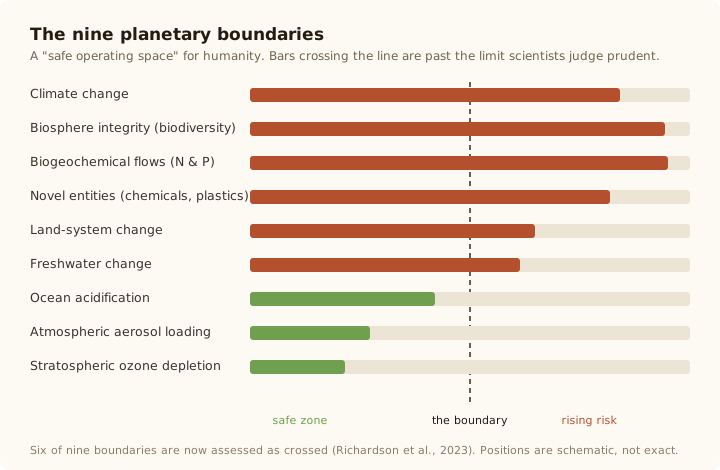
As of the 2023 assessment, six of the nine boundaries are already crossed. Positions are schematic.
Why it’s load-bearing: it reframes “the environment” from a single dial (usually temperature) to a dashboard. Climate gets the headlines, but biodiversity loss and the nitrogen cycle are, by this accounting, transgressed just as badly. It stops you from tunnel-visioning on carbon.
Concrete example: the ozone layer is the boundary we pulled back inside, through the 1987 Montreal Protocol banning CFCs. It’s the field’s clearest proof that a boundary can be respected once the world decides to.
Common misconception: that crossing a boundary means instant catastrophe. The boundaries mark rising risk, not a cliff edge — but they’re set where the science says the odds of triggering a large, hard-to-reverse change start climbing steeply.
4. There is no “away”
Matter is conserved: it doesn’t vanish when you’re done with it. Every atom you “throw away” goes somewhere — a landfill, a river, the atmosphere, an ocean gyre, or a body. “Away” is just a place you’ve stopped looking.
Why it’s load-bearing: it dissolves the fantasy of clean disposal and forces you to trace materials to their real destination. It’s the reason incineration, flushing, venting, and burying are relocations, not solutions.
Concrete example: the plastic bottle you recycle may be baled, shipped across the world, found uneconomical to process, and dumped — the same molecules, now in someone else’s river. The “away” was a supply chain.
Common misconception: that recycling makes waste disappear. Recycling is real but partial, lossy, and often downcycling (a bottle becomes carpet fiber, not a bottle). Using less in the first place beats managing waste after the fact — see the circular economy.
5. Externalities: the price is wrong
When a factory pollutes a river, the cost — sick people downstream, dead fish — is real but doesn’t appear on anyone’s invoice. Economists call that an externality: a cost (or benefit) that falls on third parties and isn’t reflected in the market price. Because the polluter doesn’t pay it, the market produces too much of the harmful thing.
Why it’s load-bearing: it’s the single deepest explanation of why environmental damage happens even when everyone involved is behaving rationally. The problem usually isn’t villainy; it’s prices that lie about true costs. And it points straight at the fix: make the price tell the truth (a carbon tax, a pollution fee, a deposit).
Concrete example: a tonne of CO2 causes real damage — heat, floods, lost crops — that studies estimate at tens to hundreds of dollars. For most of history, emitting it cost the emitter nothing. Carbon pricing exists to close that gap.
Common misconception: that pollution is caused by “greed.” Some is, but the structural cause is that clean and dirty options compete on a playing field where the dirty one’s damage is invisible in the price. Fix the price and ordinary self-interest starts pushing the other way.
6. The commons problem
A resource that everyone can use and no one owns — the atmosphere, an ocean fishery, a shared aquifer — tends to get overused. Each user gets the full benefit of taking a bit more, while the cost of depletion is spread across everyone. So everyone rationally takes more, and the shared resource collapses. That’s the “tragedy of the commons.”
Why it’s load-bearing: it explains why environmental problems are so stubborn even when everyone would be better off cooperating. It’s why global climate action is hard (every country benefits from others cutting while it doesn’t) and why solutions almost always involve coordination — treaties, quotas, property rights, or enforceable rules.
Concrete example: the collapse of the Grand Banks cod fishery off Canada in 1992. Each fleet had every incentive to catch more before rivals did; the shared stock crashed and never fully recovered, throwing tens of thousands out of work.
Common misconception: that commons are always doomed. The economist Elinor Ostrom won a Nobel for documenting hundreds of communities that governed shared resources sustainably for centuries — with clear rules, monitoring, and trust. The tragedy is a default, not a law of nature.
7. Thresholds and tipping points
Natural systems often don’t respond smoothly. You can push one for a long time with little visible change, then cross a threshold where it flips into a new state — and that new state can be self-sustaining and very hard to reverse. Ecologists call this hysteresis: the path back isn’t the path in.
Why it’s load-bearing: it’s why “we’ll fix it when it gets bad” is dangerous. Gradual causes can have sudden, sticky effects, so the safe strategy is to stay well clear of thresholds you can’t see precisely. It also explains why scientists hedge — they can tell a tipping point is near without pinning the exact temperature.
Concrete example: a clear lake receiving fertilizer runoff can stay clear for years, then abruptly turn green and murky as algae take over — and cleaning it up requires pushing nutrients far below the level that triggered the flip. Coral reefs, ice sheets, and the Amazon are suspected of similar behavior at larger scale.
Common misconception: that change is proportional to cause — that half the pressure means half the damage. Near a threshold, a small extra push can cause a disproportionate, discontinuous collapse.
8. Lags and committed change
Between cause and full effect there’s often a long delay. The ocean takes decades to warm to match the CO2 already in the air; an ice sheet takes centuries to finish melting. So the harm we experience today reflects emissions from years ago, and today’s emissions have “baked in” harm we won’t feel for years.
Why it’s load-bearing: it means feedback arrives too late to guide us. By the time a problem is obviously bad, we’re already committed to it getting worse, and stopping the cause doesn’t stop the momentum. It’s the core argument for acting before the damage is fully visible.
Concrete example: even if all emissions stopped tomorrow, sea levels would keep rising for centuries as the deep ocean and ice sheets slowly catch up to warming that’s already occurred. We’re steering a supertanker, not a bicycle.
Common misconception: that stopping emissions would quickly reverse the damage. Some things (surface air temperature) would stabilize within years; others (sea level, ice, deep-ocean heat) carry momentum that plays out over centuries.
9. Leverage: intervene upstream
In any system, some intervention points move the outcome far more than others. As a rule, acting upstream — near the driver — beats acting downstream at the symptom. Preventing a tonne of CO2 is cheaper and surer than capturing it after it’s in the air; not making a toxic chemical beats cleaning it up later.
Why it’s load-bearing: it’s how you tell high-value action from feel-good action. A lot of visible environmental effort — beach cleanups, straw bans — is downstream and small, while the upstream levers (energy systems, farm subsidies, building codes, material choices) are less visible and vastly larger. Knowing the difference is most of what makes someone effective rather than merely earnest.
Concrete example: you can hand out water filters to a village downstream of a polluting mine forever, or you can change the rule that lets the mine discharge. The filters help real people today; the rule change is the leverage point.
Common misconception: that every action helps equally and it all adds up. Impacts differ by orders of magnitude. The whole point of the major problems and the abatement cost curve is to find the big levers rather than assume they’re all the same size.