The Map
Environmental protection spans two questions: what is happening to the planet, and what can we do about it. The "what is happening" half rests on Earth-system science (the cycles of carbon, water, and nutrients) and on measurement (how we detect and quantify harm). On top sit the pressure areas — climate, air, water, biodiversity, land and food, and the waste and chemicals we release. The "what can we do" half is driven by the energy system, which underpins most of the damage, and steered by governance and economics, which decide which fixes actually happen. A useful frame is the loop from drivers (why we act) to pressures (what we emit) to state (the condition of nature) to impacts (the harm) to responses (what we do back). Protection means bending that loop.
Here’s the entire field on one page. Read it and you can hold an intelligent conversation about what environmental protection is, what its parts are, and where the hard problems sit.
The clearest way to see the domain is as a loop that human activity drives and that protection tries to bend back on itself.
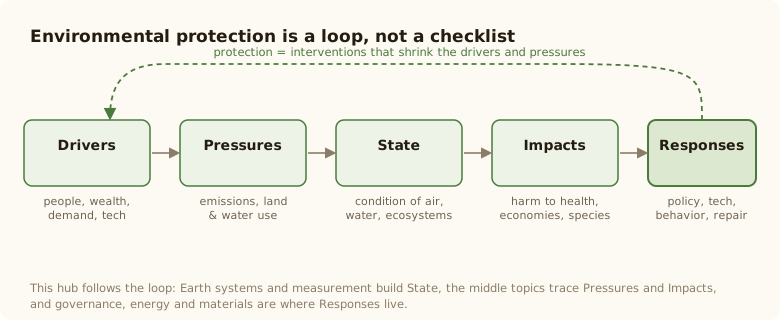
The DPSIR loop — drivers, pressures, state, impacts, responses — is the scaffolding this whole hub is built on.
Drivers are why we act at all: population, wealth, technology, and appetite for food, energy, and stuff. Drivers create pressures — the emissions, extraction, and land conversion we impose on nature. Pressures change the state of the environment: the composition of the atmosphere, the health of a river, the number of species in a forest. A changed state produces impacts — heatwaves, dirty air, collapsing fisheries, damage to health and economies. And impacts provoke responses: laws, taxes, technologies, restoration, behavior change. A good response reaches back and shrinks the drivers and pressures. That’s what “protection” actually means, mechanically.
The subfields, in plain language
The field divides into two halves — understanding the problem, and acting on it — and both rest on the same foundation.
The foundation: how the planet works, and how we know.
- Earth-system science — the study of the planet as a set of connected cycles that move carbon, water, and nutrients around and keep the surface livable. Push on one cycle and the others respond. This is the load-bearing science; nothing else makes sense without it.
- Environmental measurement — how we actually detect and quantify a problem: sensors, satellites, samples, and the statistics that turn noisy readings into a trustworthy trend. If you can’t measure it, you can’t manage it or argue about it honestly.
The pressure areas: where the damage shows up.
- Climate and carbon — the warming caused by heat-trapping gases we add to the air, mostly from burning fossil fuels. The master problem, because it amplifies most of the others.
- Air and water — the pollution of the two commons we can’t live without: the air we breathe and the fresh water we drink. Often local, often deadly, often fixable.
- Biodiversity and ecosystems — the living fabric of the planet, from soil microbes to whales, and the free services it provides (pollination, clean water, flood control). We’re thinning it fast.
- Land, food, and forests — how we use the planet’s surface to feed ourselves, and the deforestation, soil loss, and habitat destruction that come with it. Farming is the single biggest way humans reshape the land.
- Waste, materials, and toxics — everything we dig up, make, use briefly, and discard: plastics, e-waste, and the industrial chemicals that end up in places they shouldn’t.
The action half: what actually changes the outcome.
- Energy and the transition — the system that powers modern life and, because most of it still burns carbon, causes most of the emissions. Replacing it is the central engineering project of the century.
- Governance, economics, and justice — the rules, prices, and institutions that decide which fixes happen, plus the hard fact that environmental harm lands hardest on those least responsible for it.
What depends on what
Read this as a dependency tree — understand the higher items before the lower ones.
- Earth-system science (the foundation — start here)
- Environmental measurement (you need the science to know what to measure)
- Climate and carbon (a change in one Earth-system cycle, made visible by measurement)
- Energy and the transition (the main driver of climate change, and the main lever against it)
- Air and water (local pressures on shared resources)
- Biodiversity and ecosystems (the state of living systems)
- Land, food, and forests (the biggest human pressure on ecosystems)
- Waste, materials, and toxics (pressures from what we make and discard)
- Climate and carbon (a change in one Earth-system cycle, made visible by measurement)
- Governance, economics, and justice (sits over everything — it decides which responses happen)
- Environmental measurement (you need the science to know what to measure)
What this hub covers in depth vs. points to
This hub goes deep on the pressure areas and the two levers that move them — energy and governance — because that’s where an informed non-specialist gains the most leverage. It covers Earth-system science and measurement enough to make the rest legible, but it is not a geoscience or a statistics course; Go Deeper points you onward. It largely sets aside the built environment (green buildings, urban planning) and the deep specifics of environmental law, which are real subfields but a level of detail past this map. Everything here connects back to the big problems; if a topic didn’t, it wouldn’t have earned a place.