Energy & the Transition
Energy is the engine under most environmental damage: burning fossil fuels for power, transport, industry, and heat causes the majority of greenhouse emissions and much of the world's air pollution. Replacing that system is the central engineering and economic project of the century. The good news is that solar and wind are now the cheapest new electricity in most places, so the easy wins are genuinely cheap — some even save money. The hard part is everything else: the intermittency of sun and wind needs storage and smarter grids, and heavy industry, aviation, shipping, and high-heat processes have no cheap clean substitute yet. A useful way to see the whole landscape is the abatement cost curve, which lines up every option from money-saving efficiency to expensive last-resort capture — telling you which tonnes to cut first and which will fight you hardest.
Prerequisites: Climate & Carbon Feeds problems: decarbonizing energy, clean air and water
Practitioner
Almost everything upstream in this hub converges here, because energy is the engine under most environmental harm. Burning fossil fuels for electricity, transport, industry, and heat is the largest source of greenhouse gases and a huge source of the air pollution that kills millions. So the single biggest environmental project of the century is swapping the world’s energy system from carbon to clean — while demand keeps growing. Get energy right and you make the largest dent in climate and deliver cleaner air as a co-benefit.
The story splits sharply into an easy part and a hard part, and confusing the two is the most common mistake in energy debates.
The easy part: clean electricity. Solar and wind have fallen so far in cost that they’re now the cheapest source of new electricity in most of the world. This is a genuine turning point — decarbonizing the power grid is no longer a matter of paying more to be virtuous; it’s often the cheapest option outright. The main obstacle isn’t cost anymore but intermittency: the sun sets and the wind drops, but demand doesn’t. Managing that is the live challenge, and the toolkit is real and growing — batteries for short-term storage, long-distance grids to move power from where it’s sunny or windy to where it’s needed, flexible demand that shifts to when power is cheap, and firm low-carbon backup (nuclear, hydro, geothermal) for the gaps. None of these is exotic; the bottleneck is building them fast enough.
The hard part: everything that isn’t electricity. Even a perfectly clean grid leaves large chunks of the problem, and these are the frontier:
- Heavy industry. Making steel and cement needs both intense heat and, chemically, releases CO₂ as part of the process itself — you can’t fix cement just by plugging it into a clean grid. Solutions (green hydrogen, novel processes, carbon capture) exist but are expensive and early.
- Long-distance transport. Batteries are heavy; for aviation and shipping, energy density matters enormously, so electrification is hard. Candidates are sustainable fuels and hydrogen derivatives, all currently costly.
- High-temperature and dispersed heat. Industrial process heat and building heating in cold climates are large and awkward to electrify cheaply.
The reason to hold the easy/hard split in mind is that it tells you where effort and money should go, and that’s exactly what the abatement cost curve visualizes.
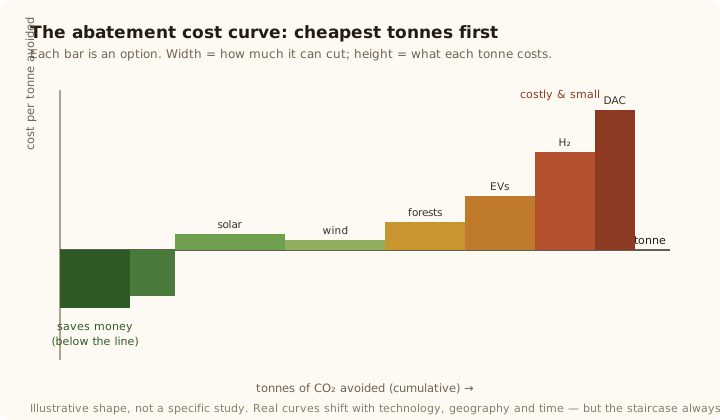
Each bar is an option: width is how much it can cut, height is the cost per tonne. Do the cheap, wide bars on the left first.
Read the curve left to right and you have a strategy. The bars below the line — efficiency, insulation, LED lighting — save money while cutting carbon, so they should be done first and are pure economic gain; the puzzle is why they aren’t already, and the answer is market barriers like split incentives (a landlord who won’t pay for insulation a tenant benefits from). Next come the cheap, wide bars — solar and wind — the workhorses. To the right, the bars climb: reforestation, then electric vehicles, then the expensive, narrow options like green hydrogen and direct air capture. Those last ones are real and may be necessary for the hard-to-abate remainder, but they’re a costly last resort, not a first move — and their existence is sometimes used to justify delay (“we’ll just capture it later”), a moral hazard worth watching for.
Two cautions keep a practitioner honest about the curve. First, it shifts over time — options that were expensive a decade ago (solar, batteries) slid down and to the left as they scaled, which is the strongest argument for investing in today’s costly options to make tomorrow’s cheap. Second, the curve prices tonnes but not speed or feasibility; the bathtub says timing matters, and the cheapest theoretical path is worthless if it can’t be built in time. Still, the shape’s lesson is durable: cut the cheap, wide tonnes first, and don’t let the glamour of expensive far-right technologies distract from the boring wins on the left.
Expert pointers
The hottest debates are about the hard part and the pace. On technology: whether green hydrogen will fall in cost enough to decarbonize industry and long-haul transport, how large a role nuclear (including small modular reactors and, someday, fusion) should play, and whether long-duration energy storage can be cracked cheaply. On strategy: the argument between those who see carbon capture and removal as essential for hard sectors and those who see it as a fossil-industry lifeline that excuses delay. And on the system level, “electrify everything” — the thesis that the cheapest path is to convert as much as possible (cars, heat, industry) to run on an ever-cleaner grid — versus the sectors where that runs out of road.
Misconceptions
- “Renewables are too expensive to replace fossil fuels.” Out of date. Solar and wind are now the cheapest new electricity in most of the world; the remaining costs are storage and grids, not generation.
- “Because the grid is easy-ish, the whole problem is nearly solved.” Clean electricity is the easy wedge. Industry, aviation, shipping, and high-heat processes are the hard majority of the remaining work, with no cheap answer yet.
- “Carbon capture lets us keep burning fossil fuels as usual.” Capture is expensive, small-scale, and best reserved for emissions that are genuinely hard to eliminate. Treating it as permission to keep emitting is the moral hazard the field warns about.
Check yourself
- Why does the abatement cost curve say to do efficiency and insulation before building solar farms — and if those options save money, why haven’t they already happened?
- Explain why a completely clean electricity grid would still leave a large share of emissions untouched. Which sectors, and why are they hard?
- What is intermittency, and name three different tools for managing it without fossil backup.
- The abatement curve shifts over time. Explain how that fact justifies investing now in options that look too expensive today.
Apply it
Sketch a rough abatement cost curve for your own life or household: list the ways you could cut your footprint (LED bulbs, insulation, less beef, an EV, flying less, a heat pump), and order them by cost per tonne saved — cheapest and money-saving first, expensive last. You don’t need exact figures; the ordering is the insight. This personal MACC is an excellent backbone for a decarbonization proposal or prototype. (~30 minutes)